My Top 9 Books in 2026 (so far)
2026-09-16
I read very errantly. Some books come and are fully read within days. Some others I read a small portion of it than let it linger for a long time before I finish them. Some are just worth the summary. And, of course, some stay pristine and never touched.
You will notice that this list has both newer books and ones from decades ago. I don't really care about making sure I read only the latest releases. Sometimes, an old book becomes a good read, either because of my current context or internal curiosity.
The books that stayed with me this year circled the same gap. The distance between how we think we operate and how we actually do. So far, these are the ones that have been highly valuable and applicable to me in 2026.
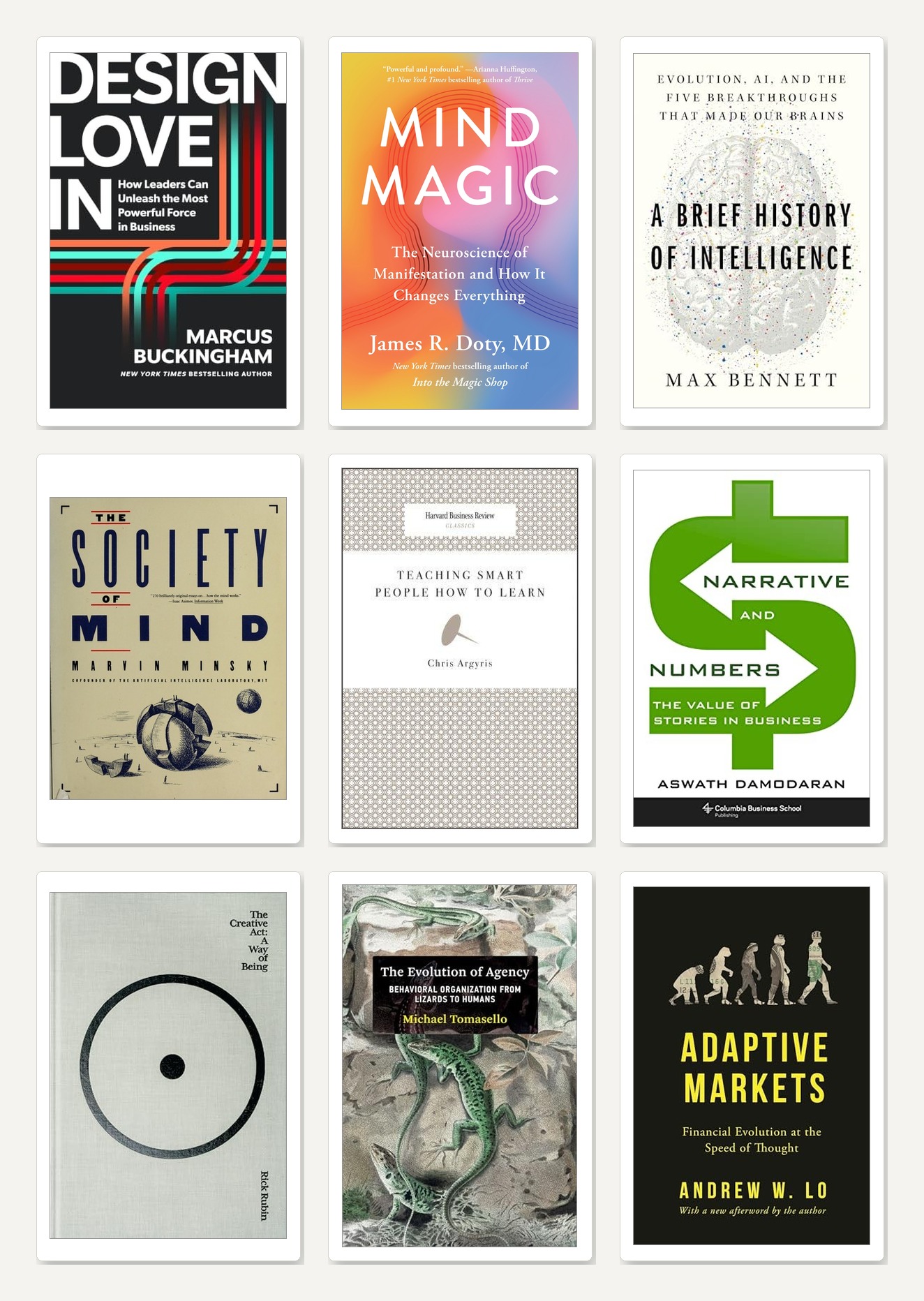
1. A Brief History of Intelligence
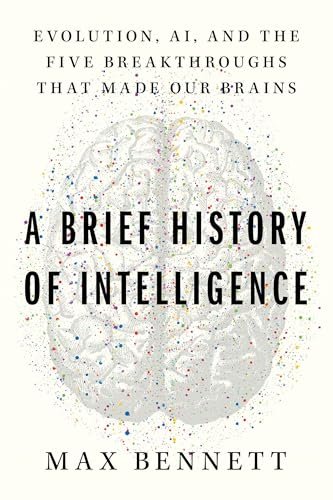
Max Bennett, 2023.
Language is the interface to our mental world.
Bennett runs four billion years of brain evolution and lands it on five moves. Five breakthroughs, each one stacked on the one before.
Steering: move toward good, away from bad. Reinforcing: learn from what you actually did. Simulating: run the play in your head before you run it for real. Mentalizing: learn from what other people do by reading the intention behind it.
Then the fifth one, and this is the whole ballgame. Language. Its magic was never coordination or giving orders. Its magic was that an idea could jump out of one skull, land in another, and outlive the person who first had it. Bennett calls us "the hive-brain apes."
That one move is why humans run the planet and chimpanzees do not. A chimp restarts near zero every generation. You woke up today standing on ten thousand years of other people's thinking, handed to you in words.
So walk into your next meeting and look at it again. That room full of talking is the fifth breakthrough, live. It is the machine that moves ideas between people and compounds them. Treat the conversation like the work, because in the deepest sense, it is the work.
Core ideas
- Human intelligence is not one invention but five evolutionary breakthroughs stacked over four billion years: steering, reinforcing, simulating, mentalizing, and language.
- The brain evolved by adding layers, never by starting over. Each breakthrough was built on the one before it.
- The same five breakthroughs that explain the brain's past also map the trajectory and limits of artificial intelligence.
2. Design Love In
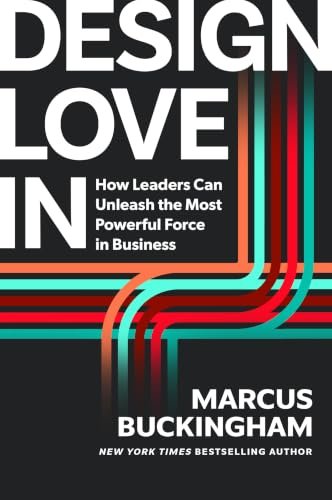
Marcus Buckingham, 2025.
Love is the driver of deliberate practice, the prime mover of discretionary effort.
Buckingham opens his newest book crying at 3 a.m., replaying the day he sold his company and blew up something he had built with love.
Then he drops a claim that sounds soft and is anything but: "Love is the most powerful force in business." Most powerful. And he brings the receipts.
The logic is a chain you can manage. Experiences drive behaviors, and behaviors drive outcomes. So when the numbers are off, stop staring at the numbers. Walk back up the chain to the experiences your people are actually living, Tuesday at 2 p.m., not in the values deck.
Love, in his definition, is the handful of feelings that make someone lean in, practice on their own time, and defend you when you are not in the room. You can design for those. You can even measure them.
That is a hard pill for a dashboard culture. The felt experience is the leading indicator. The dashboard only tells you what already happened. Lead from the front of the chain.
Core ideas
- Love is the most powerful force in business, and it is what drives discretionary effort and deliberate practice.
- Experiences drive behaviors, and behaviors drive outcomes, so leaders design the experience instead of chasing the outcome.
- Love can be broken into five feelings you can design for: control, harmony, significance, others, and growth.
- The opposite of design is drift. Love is rarely killed. It fades from neglect.
- Designing love in is a discipline: walk the stage, equip the people, and sequence the scenes.
3. Teaching Smart People How to Learn
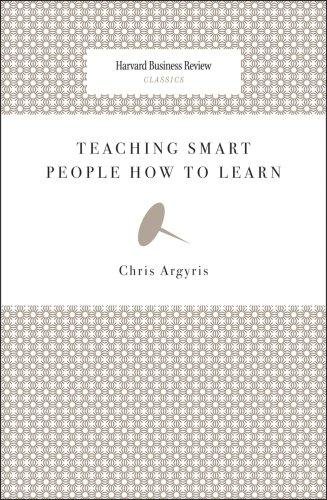
Chris Argyris, 1991.
By assuming that they can't learn, we absolve ourselves from having to.
Here is a truth nobody wants at the top of the org chart. Your smartest people are often your weakest learners.
Watch what happens the moment a star hits real failure. They explain. They deflect. They move the focus onto everyone else in the room. The learning stops cold.
Argyris names the two modes. Single-loop learning fixes the mistake. Double-loop learning asks whether the goal was wrong in the first place. Your best people are surgeons at the first and beginners at the second, because success never forced them to practice the second.
His line has been rattling around my head for months: "their ability to learn shuts down precisely at the moment they need it the most."
So quit hoping a new bonus plan fixes this. It will not. This lives in how people reason under threat, and it only moves when the most senior person in the room goes first and picks apart their own thinking out loud. Everyone else is watching to see if it is safe. Show them.
Core ideas
- The most successful professionals are often the worst learners, because success never taught them how to fail.
- Real learning requires double-loop reasoning: questioning the goal and your own assumptions, not just fixing the error.
4. Mind Magic
James Doty, 2024.
What the subconscious seeks, the conscious mind finds.
A neurosurgeon wrote a book about manifestation. I almost skipped it. Do not.
Underneath the woo, Doty is talking about attention. Whatever you mark as important, your brain goes hunting for, around the clock, whether or not you are consciously thinking about it.
Now put that on your strategy. You can write the most elegant goal in the world. If your team can recite it but never feels it and never repeats it, their brains file it under noise and move on. The brain is cheap. It ignores the unfamiliar to save energy.
Two things get past the filter. Emotion and repetition. Doty: "It is not only repetition that forms a habit; it is the positive emotion we attach to doing a good job and completing it."
And the twist most leaders miss. Goals pointed at other people stick harder than goals pointed at yourself. People feel the difference, and they show up for what they can feel.
Where attention goes, energy follows. So the real question is who is choosing your team's attention this week. You, or the calendar?
Core ideas
- Manifestation is not magic. It is attention, intention, and the brain's filtering systems at work.
- What you mark as important, the brain hunts for, consciously and unconsciously, until it finds it.
- Compassion and an open heart, not self-focused wanting, are what make the process actually work.
5. The Evolution of Agency
Michael Tomasello, 2022.
The issue is not complexity but control.
I picked this up because of one word I hear from leaders constantly. Agency. They want people who act like owners. Who push. Who grab the ball without being told.
Tomasello turns that wish into something you can actually build. Agency runs on five parts working together: a real goal, attention on what matters, a genuine decision, an action, and honest feedback on the result.
Read that as a design spec, because that is what it is. Give a person all five and ownership shows up on its own. Take one away, hide the goal, starve the information, fake the decision, skip the feedback, and that same person goes quiet. Then we shrug and call them passive.
His bigger idea is the one most leaders walk past. The strongest agency lives between people, not inside them. Two humans locked onto a shared goal become one system that drives itself forward.
So the next time you ask for more accountability, aim somewhere new. You are really asking for a tighter we. Build the connection and the ownership follows.
Core ideas
- Agency is feedback control: a creature with a goal that perceives, decides, acts, and adjusts. It is not stimulus and response.
- Agency evolved in layers of increasing control: goal-directed, then intentional, then rational, then socially normative.
- Each layer hands the organism more psychological control over its own behavior.
- Human agency is uniquely shared: two minds can hold one goal and act as a single we.
6. The Creative Act
Rick Rubin, 2023.
Competition serves the ego. Cooperation supports the highest outcome.
Rubin produced some of the biggest records of the last forty years, and he does not play an instrument or read music. His book is how that is possible, and it turns out to be a book about paying attention.
His claim: "The real work of the artist is a way of being in the world." The song, the deck, the product, that is just what falls out at the end. Train the attention and the output takes care of itself.
For teams, one idea earns the whole book. More work dies from early judgment than from any shortage of talent. Somebody floats a rough idea, the room stomps it before it grows legs, and you just taught everyone to stop floating ideas.
Two more that port straight into a company. Competition feeds the ego, cooperation feeds the result. And when you give feedback, aim at the work, never the person, because the second it gets personal, they stop listening and start defending.
Protect the seed. That is most of the job.
Core ideas
- Creativity is a way of being available to everyone, not a rare gift for a few.
- The artist's real work is awareness. Pay attention to the world and let the work come through.
7. The Society of Mind
Marvin Minsky, 1986.
The power of intelligence stems from our vast diversity, not from any single, perfect principle.
The oldest book on my list, and somehow the most relevant in the year everyone is losing their minds about AI.
Minsky's big swing: there is no single smart thing inside your head. Your mind is a pile of small, dumb parts, and intelligence is just how they get wired together.
Sit with what that does to how you see a team. You will never predict what a group produces by adding up how talented the individuals are. The output lives in the connections. In Minsky's words, you have to know "who talks to whom."
Then Papert's principle, worth the price of the book for any manager. Most growth does not require new skills. It requires a better way to run the skills already in the room. The five-year-old already holds every piece needed to solve the puzzle. What is missing is a middle manager in the mind to decide which piece to trust.
So before you post that job req for the missing skill, ask the cheaper question. Is the skill missing, or just badly wired?
Core ideas
- The mind is made of many small, mindless parts, and intelligence emerges from how they interact, not from any single principle.
- There is no central self and no magic ingredient. The self is something the mind builds.
- Papert's principle: most mental growth comes from new ways to organize what you already know, not from new knowledge.
8. Narrative and Numbers
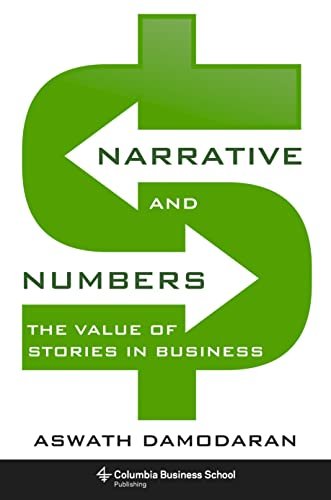
Aswath Damodaran, 2017.
Success when investing in young companies comes from getting the narrative right, not the numbers.
A valuation professor wrote one of the best books on storytelling I have read. That is the joke, and it is also the whole lesson.
His frame: "stories without numbers are just fairy tales and numbers without stories to back them up are exercises in financial modeling." Most leaders pick a side and quietly look down on the other. The storytellers wave off the spreadsheet. The finance crowd rolls its eyes at the narrative. Both walk in half-equipped.
Damodaran ties them together with one rule. Every number in your plan traces back to a sentence in your story, and every sentence shows up somewhere as a number. If a claim about your culture or your strategy cannot become a number, be honest with yourself, it is decoration.
And the line that should keep any executive up at night: if you do not tell a credible story about your company, the market writes one for you. Then you spend your quarters reacting to somebody else's plot.
One more he learned the hard way, and he put his own worst calls in the book to prove it. Refusing to update your story because it is yours is not loyalty. It is ego.
Core ideas
- Good valuation is a bridge between story and numbers, and neither survives alone.
- A number without a story is a spreadsheet. A story without numbers is a fairy tale.
- Discipline a narrative by testing it: is it possible, is it plausible, is it probable?
- Every part of the story must become a value driver, and every number must trace back to the story.
- Narratives must change as reality changes. Refusing to update yours is ego, not conviction.
9. Adaptive Markets
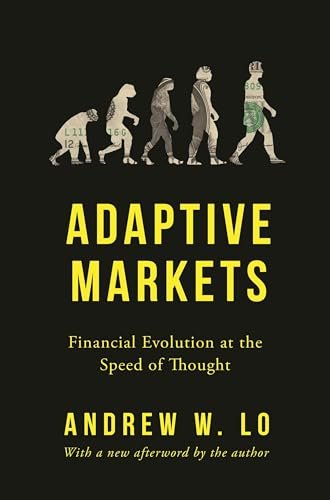
Andrew Lo, 2017.
We aren't a system with bugs; we're a system of bugs.
Lo studies markets, but the book is really about how people behave when the pressure is on.
He retires a word we lean on too hard. When someone acts badly, we call them irrational. Lo says the honest word is usually maladaptive. The behavior worked somewhere, in some environment. It just does not work here.
Small swap, huge consequence for a leader. You stop trying to fix the person and start changing the environment that keeps producing the behavior. Lo's blunt version: "It's the environment, stupid." Incentives, feedback, and what you choose to measure move people. Speeches do not.
He also defends emotion, which most managers treat as static. A patient who lost the ability to feel lost the ability to decide right along with it. Feeling is not the glitch in judgment. It is the mechanism.
And a warning for any team that has quietly trained everyone to think the same. When the shock comes, it comes for all of you at once. Nature abhors an undiversified bet.
Core ideas
- Markets are neither perfectly rational nor simply irrational. They are ecosystems that evolve.
- Market efficiency is not fixed. It rises and falls as participants adapt to their environment.
- Behavior that looks irrational is usually an old adaptation misfiring in a new environment.
- Emotion is not the enemy of judgment. Without the ability to feel, we lose the ability to decide well.
The mix of new and old here was not on purpose. But the older ones surprised me the most. They did not read as dated. They read as early.
If one of these pulls you in, tell me which. I am always curious what a book opens up in someone else.
I share new articles and ideas on LinkedIn.